
Spring is more than just a change in weather; it is a universal biological reboot. However, in the rush to see life bloom, many urban gardeners make errors that lower their soil’s “voltage” and stress the internal software of their plants.
At BLOOHOME, we work with nature’s intelligence, not against it. Avoiding these three common mistakes will save you money, time, and energy, allowing your garden to resonate at a frequency of abundance from day one, no matter where you are.
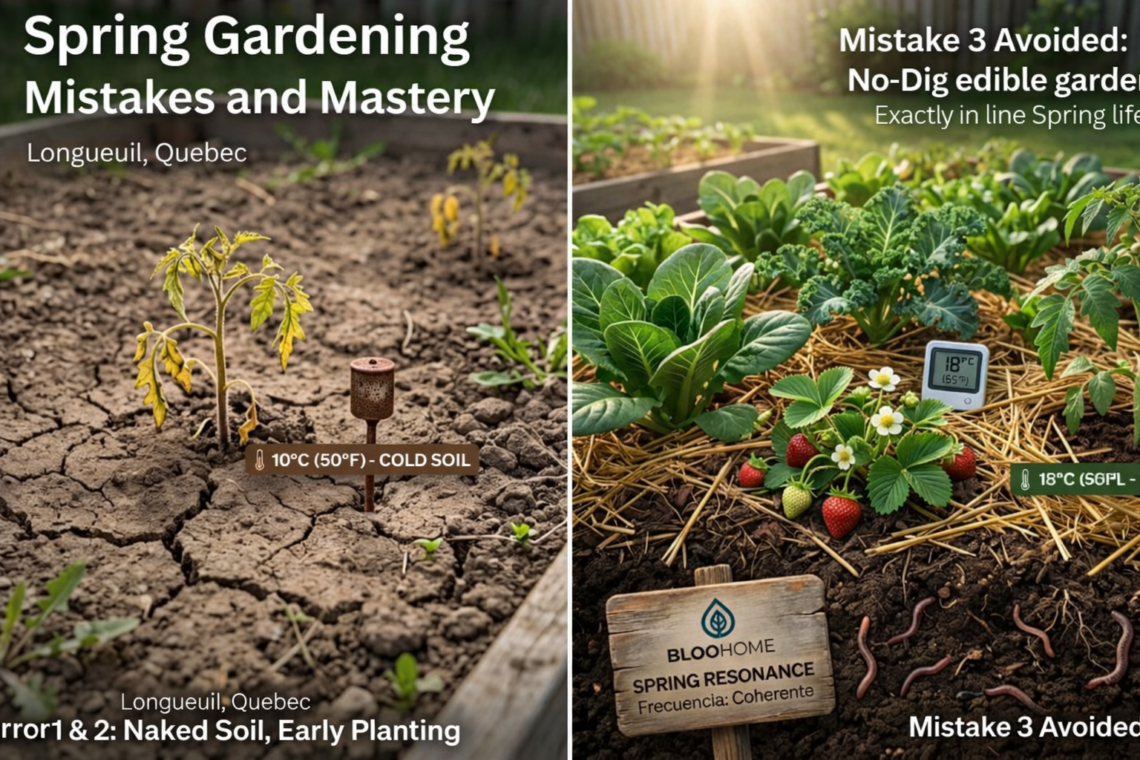
1. The “Naked Soil” Error: Ignoring Mulch
The most frequent mistake is leaving the earth exposed to the elements. In nature, soil is never naked; it is always protected by a layer of organic matter.
- The Consequence: Direct sunlight “burns” beneficial microbes and evaporates water, breaking the electrical conductivity of the roots.
- The BLOOHOME Solution: Apply a layer of mulch (straw, dried leaves, or wood chips) immediately after planting. This maintains moisture, regulates temperature, and feeds the mycorrhizal fungi that act as the “fiber optic” communication network between your plants.
2. The Calendar Error: Planting Too Early
The software of heat-loving plants (tomatoes, peppers, basil) is programmed for specific thermal frequencies. Planting them when nights are still cold causes a “thermal shock” that can take weeks to recover from.
- The Consequence: Stunted growth and immune weakness, which attracts pests—nature’s cleanup crew for plants in low-vibrational health.
- The BLOOHOME Solution: Be patient. Observe the natural indicators around you. Follow the soil temperature rather than a fixed date. If the soil feels cold to the touch, your plants’ “circuitry” isn’t ready. Use this time to prepare your kitchen-scrap fertilizers.
3. The Tillage Error: Breaking Soil Structure
Many believe they must “turn” or “till” the earth every season. Scientifically, this is a disaster for the delicate soil ecosystem.
- The Consequence: Tilling destroys carbon networks and releases $CO_2$ into the atmosphere. It also wakes up thousands of dormant weed seeds by giving them the “flash” of light they need to germinate.
- The BLOOHOME Solution: Adopt the No-Dig method. Simply add a layer of fresh compost on the surface. Worms and microorganisms will do the work of pulling nutrients down, maintaining the perfect geometric structure of soil pores so air and water flow without resistance.
Spring Frequency Summary
| Action to Avoid | Energetic Impact | BLOOHOME Correction |
| Tilling the earth | Rupture of biological circuits | No-Dig Method (Add compost) |
| Exposed soil | Loss of cellular voltage | Organic Mulching |
| Early sowing | Thermal frequency stress | Wait for consistent warmth |


